

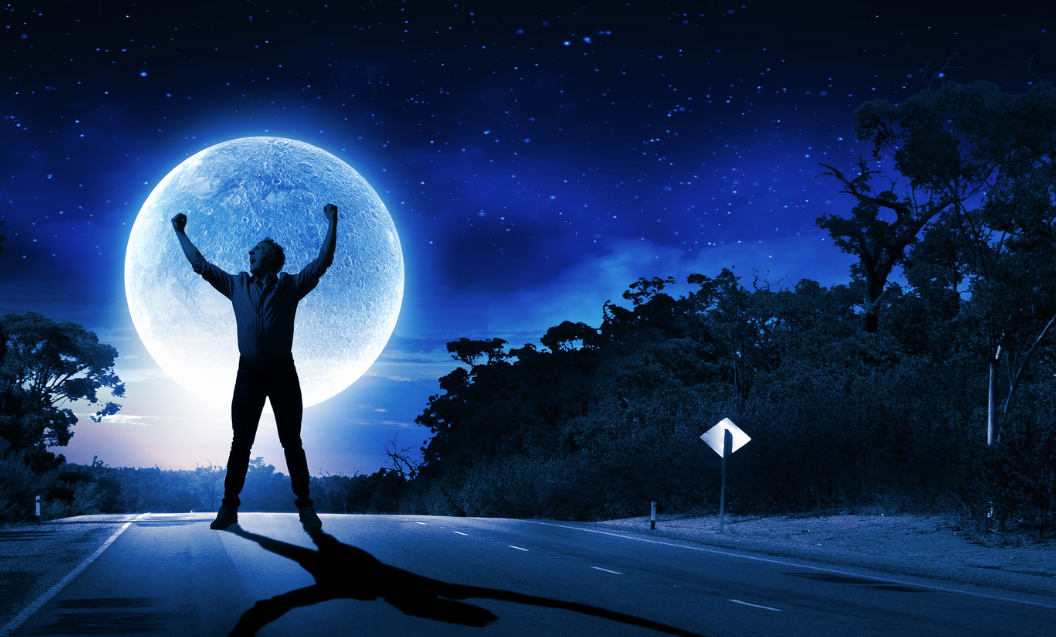
Cover: conceptual artwork with an oversized Moon, not a realistic observing scene or evidence of an emotional effect. Do not use a roadway as an observing location.
A full Moon can be a personally meaningful reminder to pause, but it does not establish why you feel sad, energetic, tired or conflicted. The earlier article claimed that the Moon controls emotions and that ocean tides make human feelings change. Those claims went beyond the evidence and should not be used to explain a person’s mental health or behaviour.
Quick Guide
- Separate a visible lunar phase from emotional interpretations.
- Do not turn the ocean-tide analogy into a claim about human moods.
- Keep journaling optional and record everyday context.
- Do not delay support or change care because of a Moon phase.
What a full Moon actually is
NASA’s Moon-phase explanation describes the full Moon as the phase when the Moon is opposite the Sun as viewed from Earth and we see nearly all of its illuminated dayside. Moonlight is reflected sunlight. The phases repeat roughly every 29.5 days.
This geometry is distinct from interpreting the Moon as a symbol of feelings, awareness or completion. A visible phase cannot reveal your hidden identity, tell you which decision is correct or guarantee a fresh start. The crescent Moon guide similarly separates phase astronomy from optional meanings.
Why the tide analogy is insufficient
NOAA’s spring-tide explanation describes slightly larger average tidal ranges around both full and new Moons, when Earth, Moon and Sun are nearly aligned. The effect concerns ocean tides and the combined gravitational influence of the Moon and Sun.
Calling water a symbol of emotions is a metaphor, not a mechanism that proves human feelings follow tides. The fact that bodies contain water does not establish the earlier claim that emotions peak at a full Moon. Do not use the analogy to predict conflict, drama or loss of control.
A research example—and its limits
A 2019 Swiss inpatient study analysed 17,966 cases and found no relationship between lunar cycles and admission rates, discharge rates or length of stay in its dataset. Those outcomes concern psychiatric services, not a direct measurement of every person’s everyday moods.
Research on lunar effects differs in design and findings. One study is not a complete review, and a memorable experience does not settle causation either. This article does not claim to diagnose an individual or establish that every possible lunar association has been ruled out. It rejects certainty that a full Moon controls your feelings.
Three distinctions for an emotional check-in
Feeling
What am I experiencing, in my own words, without assigning a lunar cause?
Context
What events, routines or unresolved concerns were present today?
Support
What practical help or conversation do I actually want?
Notice context without forcing an explanation
If you keep a short journal, note the date, your description of the day and any context you consider relevant. Include uneventful days and experiences outside a full Moon, rather than recording only a match between a feeling and a phase.
A personal record may help you formulate questions, but it is not a controlled experiment or a diagnosis. You do not have to count your emotions, monitor the Moon constantly or prove a spiritual interpretation.
An optional home or yard pause
At a modest home desk or in the yard, write one sentence about how the day felt and one question about something unresolved. You can choose a full Moon as the reminder if that symbolism appeals to you, or choose any ordinary date. The practice does not require rituals, purchases or a psychic session.
The eclipse reflection guide also keeps symbolic practices separate from promised cosmic forces. A reflective pause need not lead to a dramatic release or life decision.
Feelings are not a lunar obligation
You are not expected to be emotional, upbeat or drained on a full Moon. There is no prescribed feeling you must uncover. A symbolic reading cannot excuse harmful conduct or tell you that distress is harmless because the phase will pass.
If distress persists or affects daily life, seek qualified support rather than waiting for a new phase. Do not alter medication or other care on the basis of this article or a lunar reading. Optional reflection is not treatment and does not promise improved wellbeing.
Key Takeaways
- A full Moon is an astronomical phase, not an emotional diagnosis.
- Ocean tides do not prove that human moods follow the same pattern.
- The cited inpatient study has a specific dataset and outcome scope.
- Journaling can remain optional; needed support is independent of a lunar calendar.
Frequently asked questions
Does a full Moon control my emotions?
A lunar phase does not establish the cause of a particular feeling. Do not treat Moon symbolism as a diagnosis, an explanation for loss of control or proof that emotions will intensify.
Do ocean tides prove a full-Moon mood effect?
No. Ocean tides involve the gravitational interaction of Earth, Moon and Sun. That physical process does not establish that water in a human body produces matching emotional changes.
Can I use a full Moon as a journaling reminder?
Yes, if you freely enjoy the symbolism. Keep the practice optional, include ordinary context and contrary observations, and do not expect a guaranteed reset or healing effect.
Should I wait for the Moon to change before seeking help?
No. Do not delay needed support or change treatment because of a lunar phase. If distress is persistent or affects daily life, seek qualified support independently of the Moon.