

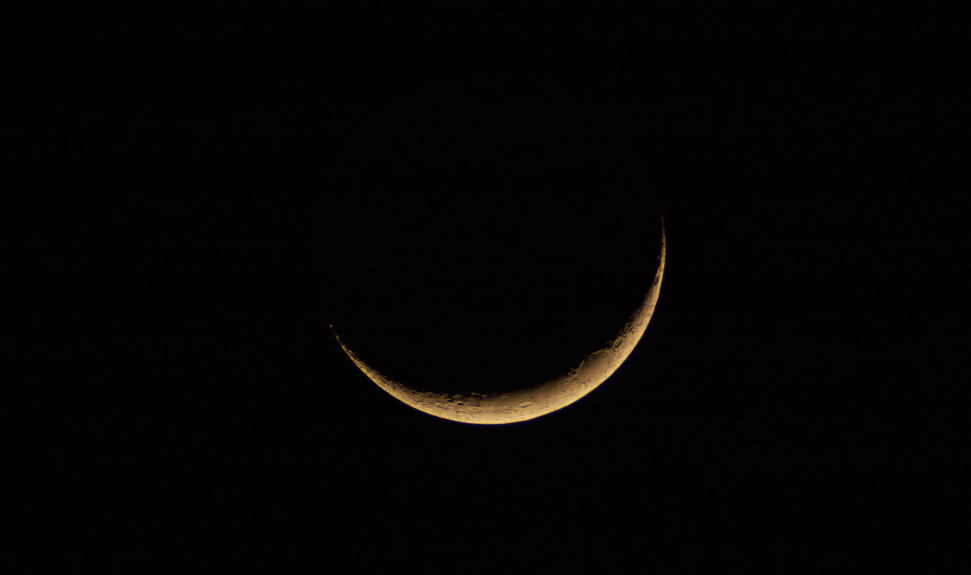
Cover: crescent-themed imagery, not evidence of spiritual power or a personal prediction.
A crescent Moon has a physical explanation and may also carry a personal symbolic meaning. Those are different questions. Its appearance cannot establish that transformation, emotional healing or a new opportunity is destined.
Quick Guide
- Identify waxing or waning by the phase sequence, not an omen.
- Separate reflected sunlight from optional spiritual metaphors.
- Use sightings and dreams as questions, not forecasts.
- Keep fertility, health and consequential decisions evidence-based.
The physical crescent
NASA’s phase guide explains that moonlight is reflected sunlight. As the Moon orbits, our view of its illuminated half changes. The phase cycle repeats in about 29.5 days.
A waxing crescent follows new Moon as the visible sunlit portion increases. A waning crescent follows last quarter and precedes new Moon as it decreases. The Moon does not physically grow or shrink. Ordinary phases are not Earth’s shadow crossing the Moon; that is a lunar eclipse.
Three optional personal prompts
Beginning
What small step would you like to try? A symbol does not establish the right timing.
Balance
What needs attention or rest? Choose from actual circumstances rather than a promised return of light.
Simplifying
What can be adjusted or set aside? No phase obligates forgiveness or emotional release.
Meaning depends on context
A crescent in art, jewellery, a religious setting or a personal notebook may have different meanings. Do not assume one universal tradition or interpret another person’s beliefs from the shape alone. Ask about its context rather than treating it as a generic manifestation emblem.
You may use growth, hope or rest as your own metaphors without claiming a historical origin or supernatural mechanism. A waxing phase is not inherently positive, and a waning phase is not evidence of decline in someone’s life.
Intuition without a cosmic instruction
A feeling of connection can be meaningful without proving that the universe is sending advice. Write down an impression, look for supporting and contradicting information, and allow uncertainty. The grounded intuition-practices guide separates optional reflection from certainty.
A crescent sighting does not tell you to change careers, begin a relationship or take a risk. Actual information, other people’s consent and practical constraints matter more than interpreting repeated appearances as confirmation.
Dreams are not an outcome guarantee
As an invented journaling prompt, someone who dreams of a crescent might ask, “What does beginning or resting mean to me today?” That is not a diagnosis or prediction. The same image can suggest something different to another person.
A dream cannot establish that emotional stability, a new chapter or a healing process is underway. Do not force an interpretation that does not fit. If reflecting becomes distressing, stop and choose suitable support rather than repeatedly searching for a message.
No gender or fertility test
Some people choose feminine or nurturing symbolism personally. That does not assign traits by gender or establish an effect on menstruation, fertility or health. No one needs to identify with a divine-feminine metaphor to appreciate the Moon.
Do not use a crescent phase as a fertility indicator, treatment timetable or assessment of wellbeing. Health questions need appropriate evidence and qualified care, not an astrological association.
A simple home reflection
- Choose a comfortable home-desk or yard seat, without ceremonial purchases.
- Write one optional meaning and one practical question.
- Choose a small realistic action if you want one.
- Review what actually happens, including outcomes that contradict the interpretation.
For fire-free routines and the difference between rituals and astronomical events, see the eclipse and moon-reflection guide. You can reflect indoors or on any convenient day; a phase does not amplify intentions or guarantee success.
Key Takeaways
- Crescent phases describe changing visible sunlight, not physical growth.
- Personal meanings are optional and context-dependent.
- Dreams and sightings do not establish future events.
- Symbolism is not health guidance or a manifestation guarantee.
Frequently Asked Questions
What is a crescent Moon?
It is a phase in which less than half of the Moon’s visible disk appears sunlit. Its shape reflects our changing view of the illuminated Moon, not a change in the Moon’s physical size.
How do waxing and waning crescents differ?
A waxing crescent follows new Moon as the visible sunlit portion increases. A waning crescent follows last quarter and precedes new Moon as that portion decreases.
Is a crescent sighting or dream a prediction?
No specific event is established by a sighting or dream. You may choose a personal meaning, but it does not prove a new relationship, career change or emotional recovery is coming.
Does crescent symbolism determine fertility or amplify goals?
No. A crescent is not a fertility indicator, health test or mechanism for guaranteed manifestation. Use appropriate real-world information and treat symbolism as optional reflection.