

A full Moon does not tell you what you must feel or establish why you feel it. You may enjoy its symbolism as a reminder to pause, but this article does not promise emotional release, total healing, better sleep or a breakthrough.
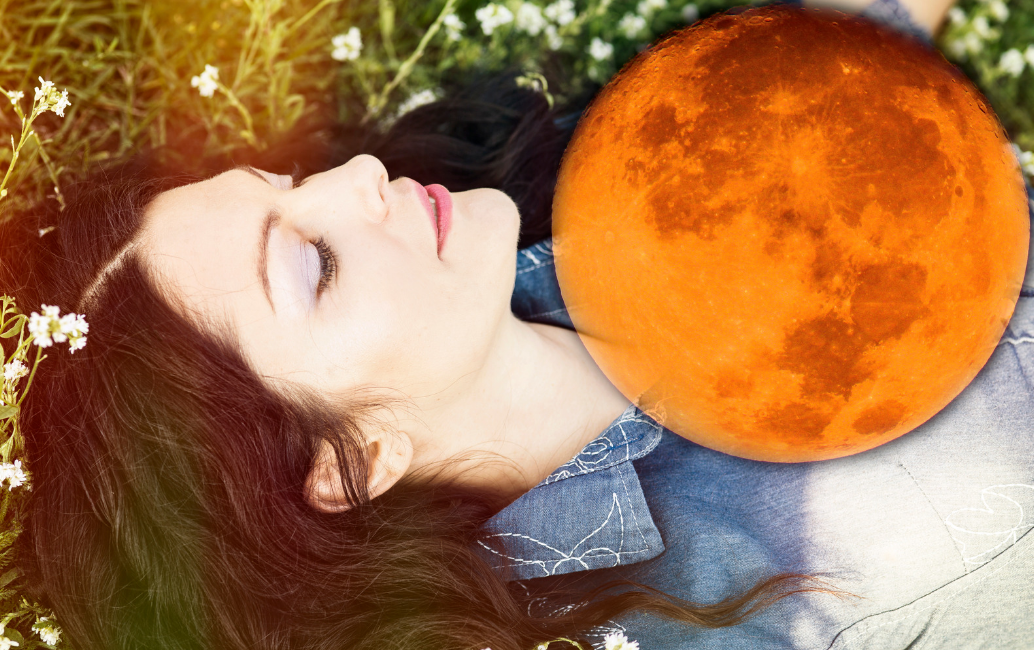
The cover is conceptual artwork: a woman outdoors with an oversized orange Moon composited over her torso. It is not a real healing object, a normal-size Moon or evidence of an emotional effect.
Quick Guide
- Describe the feeling without assigning a lunar cause.
- Notice relevant ordinary context.
- Keep reflection optional and free of healing guarantees.
- Seek appropriate support independently of Moon phases.
Describe the feeling, notice context, choose support
Describe the feeling
Use your own words without deciding a planet caused the experience.
Notice ordinary context
Consider what happened today and what remains unresolved.
Choose appropriate support
A symbolic pause is not treatment or a reason to postpone help.
A visible phase is not an emotional diagnosis
NASA’s phase explanation describes moonlight as reflected sunlight. At full Moon, we see nearly all of the illuminated dayside. The phase cycle is approximately 29.5 days; that is not the same measurement as one orbit against the distant stars.
The ordinary phases are about our view of the illuminated portion, not the Moon entering the Sun’s shadow. An ordinary new Moon is not automatically a solar eclipse. The crescent Moon context guide similarly separates astronomy from optional meanings.
Those physical descriptions do not establish what a particular person feels or provide a mechanism for “total healing.”
Describe an experience without a prescribed mood
You might feel calm, frustrated, excited, tired or nothing unusual on a full-Moon day. There is no hidden feeling you are required to uncover. A difficult evening does not prove lunar energy brought emotions to the surface.
This discussion of full-Moon emotional claims and research scope distinguishes symbolic meaning from causal certainty. A phase label alone cannot explain anxiety, difficulty concentrating or poor sleep.
Notice context rather than force an explanation
If you choose to write a note, record what happened and what you wanted, not just a match between a Moon phase and a feeling. Include uneventful days and examples that do not fit your initial story.
A personal note is not a controlled experiment or a diagnosis. You need not monitor the Moon constantly, score every feeling or prove that a symbolic explanation is correct.
Optional reflection is not energy treatment
A full Moon may serve as a personally chosen reminder, just as another date can. That does not establish that energy work will remove what holds you back, improve sleep, provide peace or produce a breakthrough.
No ritual, paid session, candle or dramatic release is required. You can stop the exercise if it is not useful. Do not interpret a lack of relief as insufficient intention or a failure to accept healing.
Appropriate support does not wait for a phase
NIMH’s mental-health guidance notes that self-care differs between people and advises talking with a health-care provider about concerns. A notebook prompt is not a substitute for that assessment.
If distress is persistent, severe or affects daily life, seek qualified support rather than waiting for another phase. A calendar cannot declare symptoms normal or harmless. Do not change prescribed care because of this article, and do not postpone a safety-related choice to complete a lunar practice.
No forced expression or gratitude
You do not owe anyone a disclosure, emotional performance or thankful response to a painful experience. “You will be okay no matter what” is not a reliable safety guarantee, and this article does not make that promise.
You can acknowledge an unpleasant feeling without calling it a necessary spiritual lesson. A symbolic practice cannot excuse harmful conduct or require you to stay in a situation you do not choose.
Six optional home-notebook questions
These newly invented editorial questions are not therapy, a diagnostic test or a lunar prediction. At an ordinary home desk, choose one if useful, or skip them.
- How would I describe today in my own words?
- What happened that I can actually observe?
- What ordinary context might matter?
- Which experience does not fit my initial explanation?
- What help do I want, and from whom?
- Would stopping this exercise be the better choice today?
Key Takeaways
- A phase does not diagnose a feeling or symptom.
- Optional symbolism does not establish a healing mechanism.
- There is no duty to release emotions or express gratitude.
- Support and safety choices are independent of a lunar calendar.
Frequently asked questions
Does a full Moon explain my anxiety or a difficult feeling?
A lunar phase does not establish the cause of your symptoms or make distress automatically harmless. Consider your actual circumstances and seek qualified support when needed.
Can lunar energy guarantee total healing or better sleep?
No. This article offers no treatment or healing guarantee. A personally meaningful Moon reminder is not evidence that energy work will improve sleep or resolve distress.
Should I wait for another Moon phase before getting help?
No. Needed support is independent of a lunar calendar. Do not change prescribed care or postpone a safety-related decision because of a phase.
Must I release emotions or feel grateful during a full Moon?
No. Reflection is optional, and there is no required emotion, disclosure or gratitude. You may stop or skip the exercise without failing a spiritual practice.