

Updated
A natal chart, or birth chart, maps celestial positions for a recorded birth date, time and place. Astrologers interpret those positions through a symbolic tradition. A chart can supply reflection prompts; it does not establish your personality, prove a karmic history or determine your future.
Start with the information used to calculate the chart
Write down the birth date, recorded local time and location. Note the source of the time: an official record, a family recollection or an estimate. Check the date format and whether a time is AM or PM. The chart tool also needs the appropriate time-zone and daylight-saving information for that place and date.
Keep the original details beside the chart so you can check them later. A neat-looking wheel can still be based on a typing error. You do not need to post a birth certificate or another person’s private information publicly to ask a chart question.
Learn four different parts of the chart
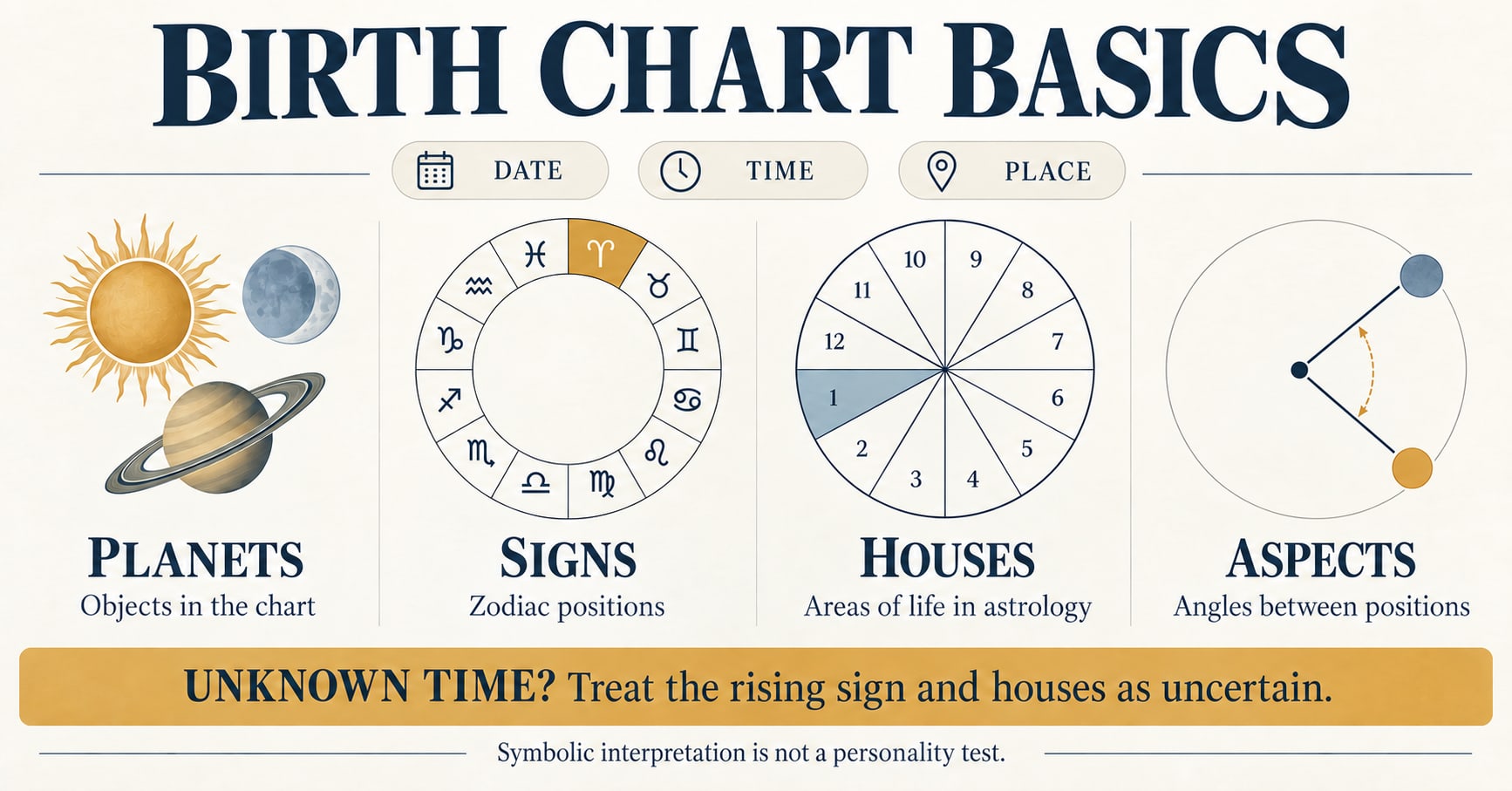
- Planets and luminaries: which object?
- The Sun, Moon and planets have positions in the chart. Astrological writing often groups the Sun and Moon with the planets, even though astronomy classifies them differently.
- Signs: which zodiac position?
- A sign locates an object within the chosen zodiac system. Astrologers attach symbolic qualities to signs. A Sun sign is one placement, not a complete description of a person.
- Houses: which area of life in the interpretation?
- Astrologers divide a chart into twelve houses and associate them with topics such as relationships or work. Houses and zodiac signs are different concepts.
- Aspects: which angle between positions?
- Aspects describe selected angular relationships between chart positions. Their meanings belong to the interpretation; an angle does not prove that two planets control a life event.
The featured infographic summarizes these four elements. For the traditional terminology and its context, see Deborah Houlding’s Skyscript explanation of houses. It describes astrological practice, rather than scientific evidence that house meanings predict events.
Understand the rising sign without a timing shortcut
The ascendant is the point of the zodiac rising at the eastern horizon for the chart’s time and location. “Rising sign” names the sign containing that point. See Houlding’s ascendant definition for a technical explanation.
The rising sign does not change on a universal fifteen-minute schedule. Signs take different amounts of time to rise at different latitudes, as explained in Skyscript’s guide to long and short ascension. A precise recorded time matters, but a precise calculation is still separate from the claims made about its meaning.
Handle an unknown birth time honestly
Use a tool’s unknown-time setting where available and keep the uncertainty visible. A default noon time is a calculation placeholder, not a recovered birth time. Do not treat the resulting rising sign and house placements as established.
Ask the reader which placements could change during the possible time range. Even a sign placement should not be assumed certain if the relevant object crosses a sign boundary during that interval. Estimating a time from personality traits does not independently confirm the estimate.
Check settings before comparing two charts
Two websites can display different charts because they use different zodiac systems, house systems, input details or time conversions. Save the settings and compare those first. A changed house placement is not evidence that your past changed or that a website discovered a different destiny.
For a related example of why the selected date and event matter, our guide to national astrology and historical chart choices separates documented events from chart construction and interpretation.
Turn a symbolic interpretation into a useful question
Suppose a reader associates a placement with communication. Instead of accepting “you always avoid conflict,” ask: “When did I speak directly this week, and when did I hold back?” Record examples that fit and examples that do not. Choose one practical conversation skill to try, then assess what actually happens.
Our zodiac reflection exercises with reality checks use a similar distinction between impressions and observations. You can enjoy symbolism while allowing your experience to contradict it.
NASA’s explanation of constellations distinguishes astronomy from astrology and notes that astrological predictions are not based on scientific evidence. Use a birth chart as optional reflection, with decisions about health, money, work and relationships grounded in relevant facts and support.
Frequently asked questions
1. Is a natal chart the same as a birth chart?
Yes. In this context both terms refer to a chart calculated for birth details and interpreted using an astrological system.
2. What information do I need to make a chart?
Start with the birth date, local birth time and birthplace. Note whether the time comes from a record, a recollection or an estimate.
3. Is my Sun sign my whole birth chart?
No. The Sun sign is one placement. A chart also includes other celestial positions and, when the necessary details are known, an ascendant and houses.
4. What is the difference between the ascendant and rising sign?
The ascendant is a particular zodiac point at the eastern horizon. The rising sign is the zodiac sign containing that point.
5. Does the rising sign change every fifteen minutes?
No. There is no universal fifteen-minute schedule. Rising times depend on the sign and the latitude, so a timing shortcut cannot replace a calculation.
6. Can I use a birth chart without knowing my birth time?
You can explore placements while clearly recording the uncertainty. Do not present a placeholder time as known or rely on its rising sign and houses.
7. Why did a calculator give me a noon birth time?
Some tools use noon as a default when no time is entered. Check the tool settings; a default does not mean that you were born at noon.
8. Can a family memory confirm the exact birth minute?
Treat a remembered time as an estimate unless a reliable record supports that precision. Tell the reader about the uncertainty instead of making the time appear exact.
9. Why do two chart websites show different houses?
Check the birth details, time conversion and house system. Different settings can produce different house placements even when the websites use the same birth date.
10. Are houses the same thing as zodiac signs?
No. Signs describe positions within a zodiac system. Houses divide the chart into sections that astrologers associate with areas of life.
11. Are the Sun and Moon actually planets?
No. The Sun is a star and the Moon is Earth’s natural satellite. Astrology often discusses them alongside planets as chart factors or luminaries.
12. Can a birth chart prove that I have psychic abilities?
No. An interpretation of a placement does not establish paranormal ability. Claims about abilities require evidence beyond symbolic associations.
13. Does a difficult placement mean something bad must happen?
No. A chart interpretation is not a verified forecast of harm. Do not treat an alarming description as a reason to fear an unavoidable event.
14. Do I need to upload my birth certificate for a reading?
Ask why any document is requested and how it will be handled. Sharing the necessary details is different from publicly posting a document with additional personal information.
15. How can I use a chart without letting it define me?
Turn an interpretation into a question, look for examples that fit and do not fit, and choose a practical action you can evaluate. You can reject a description that does not match your experience.