

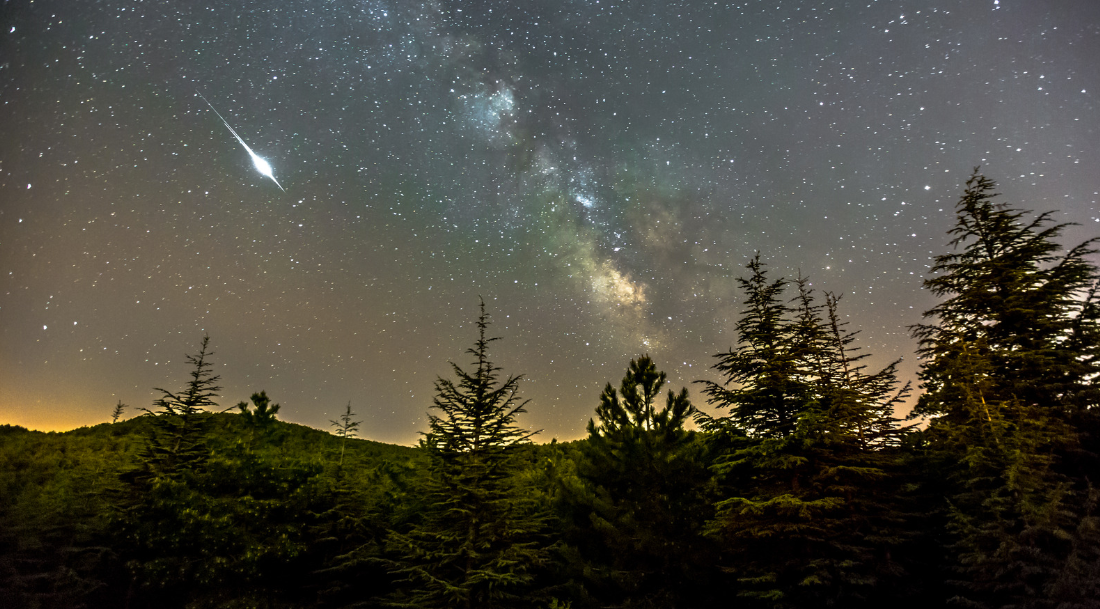
Cover: illustrative night-sky scenery, not a verified photograph of a particular shower or a promise of the view from your location.
Meteor showers can be interesting skywatching events and occasions for personal reflection. Their physical cause and the meaning someone chooses to give them are different questions. Enjoying a shooting star does not require believing that it predicts a relationship, disaster or message from a higher power.
Quick Guide
- A shooting star is a meteor, not a star falling from the sky.
- Separate astronomical explanations from personal wishes.
- Check a current, dated observing guide rather than treating an old peak table as this year’s schedule.
- Choose safety and an affordable plan over a guaranteed spectacle.
Meteoroid, meteor and meteorite
NASA’s meteor facts distinguish a meteoroid in space, the meteor seen when material enters an atmosphere, and a meteorite that reaches the ground. Showers occur as Earth crosses debris trails, usually left by comets and sometimes asteroids. Most shower particles burn up; NASA advises against expecting meteorite finds afterward.
These distinctions matter when a dramatic image or story suggests that every light streak delivers a physical stone. An ordinary shower is an opportunity to observe, not a reason to search someone else’s land or buy a supposed object linked to your sighting.
Three separate questions
Observation
What did I actually see, and under what conditions?
Meaning
What personal thought did the experience bring up?
Choice
What ordinary action, if any, do I want to take?
These are independently invented notebook prompts, not a technique for decoding universal messages. “I saw a bright streak” is an observation. “It reminded me to finish a project” is a personal association. “My partner is destined for me” goes beyond what the observation can establish.
Wishes without guarantees
You can make a wish if that feels enjoyable. Treat it as an expression of hope rather than proof that a result will happen. Missing a meteor does not mean you lost an opportunity, offended the universe or failed spiritually.
A relationship still depends on mutual interest, consent and actual conduct. A sky event cannot reveal another person’s hidden feelings or oblige someone to stay, return or forgive. Do not spend money on a reading, ritual or extra session because someone says the sighting demands it.
Do not turn broad cultural claims into history
There is no single belief shared by every spiritual person, every community in Asia or all Indigenous peoples. Claims about a named community require a specific, credible source and context. This article does not repeat the earlier plague, fire, reincarnating-soul or gods-opening-the-sky stories as verified history.
If a family tradition matters to you, describe it as that tradition rather than speaking for an entire culture. Respectful reflection does not require presenting an omen as a fact about the future.
Plan the viewing, not a prediction
In its August 2026 Perseid guidance, NASA recommends dark skies, about 20–30 minutes for eyes to adjust, looking up and being patient. That page describes a particular past August event; it is not a schedule for tonight or every shower.
Before going out, check the date, local observing time, weather, Moon conditions and accessibility in a current shower guide. Bright surroundings and blocked or cloudy views can make an outing disappointing. No published ideal rate guarantees how many you will personally see.
Our guide to crescent Moon phases and symbolic context helps distinguish an observable phase from a chosen interpretation. The Moon’s appearance is not a verdict on whether your wish deserves an answer.
A modest yard session
A safe, permitted yard may be enough for a first attempt if it has a suitable view. You do not need a professional observatory, elaborate equipment or an expensive rural getaway to make the experience worthwhile. If conditions are poor, staying home or trying another night is a valid choice.
Choose stable ground and appropriate clothing, and keep necessary safety lighting available. Do not lie in a roadway, climb a roof, trespass or turn off lighting needed for safe movement. Check local access rules before using a park after dark. Leave if weather or the surroundings become unsafe.
A grounded journal entry
At a home desk afterward, note the date, approximate time, location description without private address details, sky conditions and what you saw. Put a personal interpretation in a separate sentence. Record no sighting honestly; you do not need to invent a sign to make the evening count.
An invented example: “I saw one streak and thought about a friend. I will ask whether they want to catch up.” The friendly invitation is a choice, not evidence that the meteor transmitted their thoughts. For more optional practices, see intuition reflection with evidence limits.
Key Takeaways
- The astronomical explanation does not verify a spiritual prediction.
- Personal rituals remain optional and do not create obligations.
- Dated guides and actual conditions matter more than spectacular cover images.
- Safety, permission and your budget come first.
Frequently asked questions
What causes a meteor shower?
Earth passes through a trail of debris, usually from a comet and sometimes an asteroid. Small particles entering the atmosphere produce the light streaks called meteors.
Does a shooting star prove a wish or soulmate connection?
No. You may make a wish as a personal ritual, but a meteor does not verify a prediction, another person’s feelings or a relationship’s safety.
How can I start watching without an expensive trip?
Consider a safe, permitted yard or nearby accessible observing area with an open sky. Check current conditions and a dated shower guide, allow your eyes to adjust, and accept that sightings are not guaranteed.
Should I expect to find meteorites after a shower?
No. NASA explains that most shower material burns up in the atmosphere. A light streak is not evidence that a collectible rock has landed nearby.