

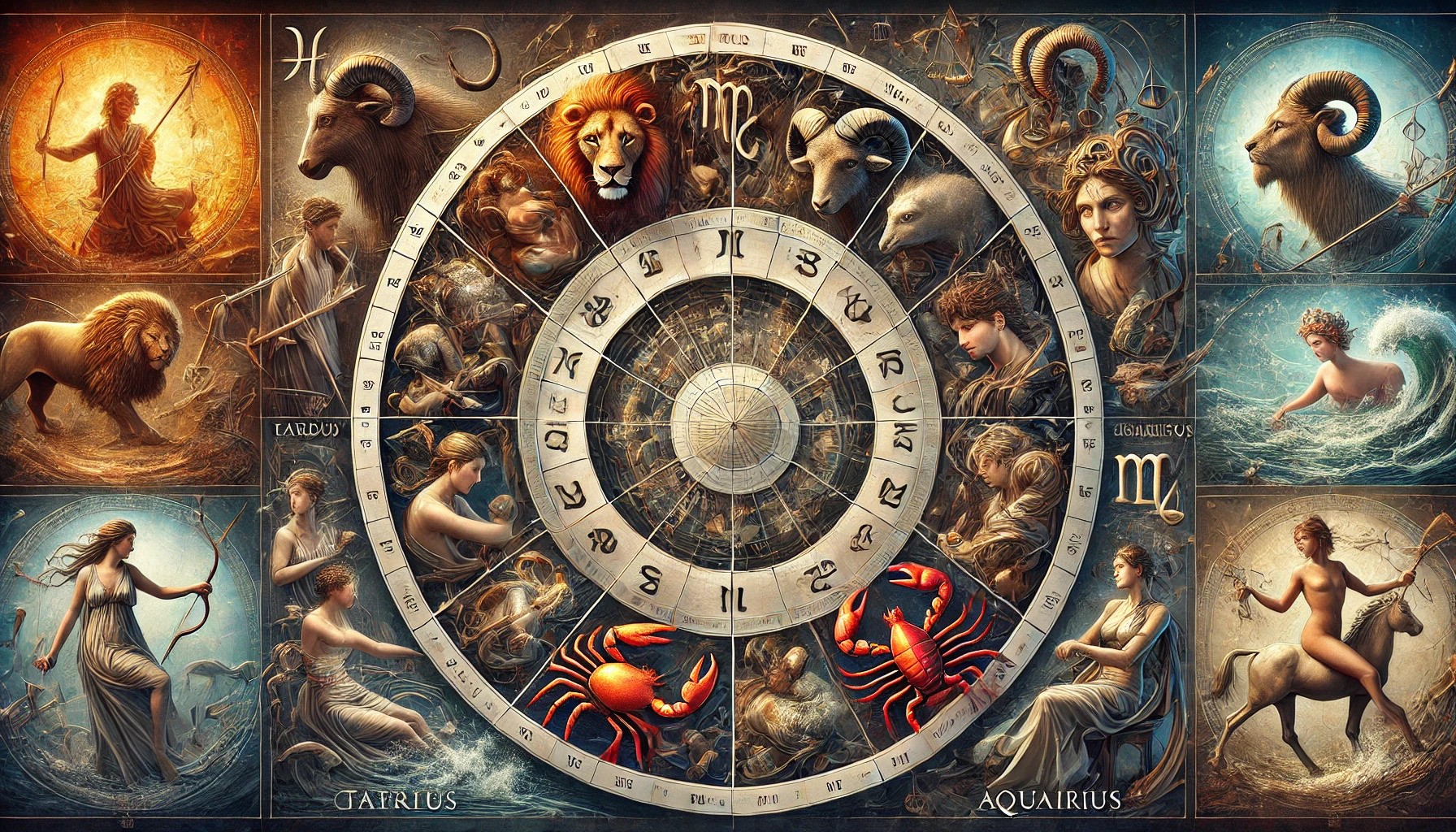
Cover: an ornate fantasy zodiac wheel with illustrated sign figures and partial labels. It represents astrological symbolism, not a scientific personality test or evidence that birth signs determine behavior.
Zodiac personality lists assign memorable qualities to the twelve Sun signs. They can be enjoyable symbolic language, but they are not established psychological assessments. A birth date cannot prove that someone is ambitious, practical, intuitive, humanitarian, emotional or any other fixed trait.
Use a sign description as a prompt to examine your own examples and exceptions. Keep the traditional vocabulary separate from observed behavior, and allow yourself or another person to reject a description that does not fit.
Quick guide
- A Sun sign is an astrological label, not a personality diagnosis.
- Elements and modalities are symbolic classification systems.
- Turn a trait word into a neutral, situation-specific question.
- Look for counterexamples instead of collecting only matches.
- Do not use signs to rank intelligence, kindness, danger or human worth.
Three layers that are often blended together
Traditional symbolism
Sign, element, modality, ruling-planet and mythic associations belong to an astrological interpretive system.
Personal interpretation
A reader decides what a phrase such as “bold” or “grounded” means and which memories seem to fit it.
Observable conduct
A specific choice, statement or repeated action can be described without assuming that a sign caused it.
The zodiac foundations guide explains signs, date ranges, elements, modalities and chart layers. This page has a narrower purpose: auditing the personality words commonly attached to the twelve Sun signs.
Twelve symbolic trait prompts—with room to disagree
These are newly written reflection prompts based on familiar astrological vocabulary. They are not claims about everyone born under a sign. Anyone may use any prompt.
Aries
Traditional words: initiative, courage, action.
Ask: In which situations do I prefer to begin, wait, collaborate or decline?
Counterexample: Recall a time you chose patience or support rather than taking the lead.
Taurus
Traditional words: steadiness, comfort, resources.
Ask: Which routines help me, and when do I welcome change?
Counterexample: Note a change you made quickly or a comfort you did not value.
Gemini
Traditional words: curiosity, exchange, variety.
Ask: Which topics hold my attention, and how do I signal that I need focus or quiet?
Counterexample: Identify a long-term interest or a situation where you preferred silence.
Cancer
Traditional words: care, belonging, protection.
Ask: What support do I welcome, and what remains private?
Counterexample: Remember when you wanted independence instead of nurturing or home time.
Leo
Traditional words: expression, creativity, visibility.
Ask: When does recognition feel welcome, and when would I rather share attention?
Counterexample: Recall a private contribution or a moment you avoided the spotlight.
Virgo
Traditional words: analysis, craft, improvement.
Ask: When is detail useful, and when is “good enough” the wiser choice?
Counterexample: Note a spontaneous decision or an imperfection you accepted comfortably.
Libra
Traditional words: balance, relationship, fairness.
Ask: How do I decide when preferences conflict, and which compromise is unacceptable?
Counterexample: Recall a firm decision you made without consensus.
Scorpio
Traditional words: depth, privacy, transformation.
Ask: Which information do I share, with whom, and under what conditions?
Counterexample: Identify a low-stakes topic you treated lightly or disclosed easily.
Sagittarius
Traditional words: exploration, meaning, breadth.
Ask: Which experiences expand my perspective, and which commitments keep me grounded?
Counterexample: Recall a familiar routine or local place you preferred to novelty.
Capricorn
Traditional words: structure, responsibility, long-range goals.
Ask: Which responsibilities are mine, and what pace is realistic now?
Counterexample: Note a playful choice, revised plan or goal you intentionally released.
Aquarius
Traditional words: independence, systems, community.
Ask: Where do I want autonomy, and where do I value shared decisions?
Counterexample: Recall a tradition you embraced or a time personal needs outweighed a group goal.
Pisces
Traditional words: imagination, compassion, permeability.
Ask: How do I distinguish empathy, assumption and a request for help?
Counterexample: Identify a practical boundary or fact-based decision you maintained clearly.
Elements and modalities are categories, not causes
Astrology groups Aries, Leo and Sagittarius as fire; Taurus, Virgo and Capricorn as earth; Gemini, Libra and Aquarius as air; and Cancer, Scorpio and Pisces as water. It also calls signs cardinal, fixed or mutable according to their seasonal positions. These labels organize symbolism; they do not demonstrate that fire signs are passionate, earth signs practical, air signs intellectual or water signs intuitive.
A full natal chart adds more symbolic placements, but more detail does not turn the interpretation into a scientific personality profile. Sun, Moon and rising descriptions cannot reveal private thoughts, consent, mental health, intelligence, honesty or future conduct.
A five-step trait-audit method
- Quote the trait. Write the exact phrase, such as “Leos crave attention,” rather than softening it after the fact.
- Define the behavior. Decide what would count as attention-seeking in a specific context and what would not.
- Look for matches and misses. Record examples that fit, contradict or remain ambiguous.
- Consider other contexts. Age, culture, role, health, resources, learning and the immediate situation may matter.
- Choose without the label. Make a decision from actual needs, conduct and evidence rather than a sign verdict.
Do not turn descriptions into excuses or accusations
Calling jealousy “Scorpio intensity,” anger “Aries fire” or control “Capricorn leadership” can hide the conduct that needs attention. Likewise, a favorable sign description cannot guarantee kindness, reliability or safety.
The conduct and agreement guide for negative-trait claims focuses on specific events, boundaries and relationship choices rather than sign-based flaws. People remain responsible for their behavior regardless of astrology.
Personality, health and identity limits
Do not use a horoscope to diagnose anxiety, depression, trauma, addiction, neurodivergence or any other health condition. Do not infer sexuality, gender, ethnicity, religion, disability, fertility or family role from a sign. Astrology may be part of personal identity or spiritual practice, but it is not permission to define someone else.
Decision boundary: zodiac traits should not decide medical, legal, financial, employment, education, housing or safety matters. Use relevant evidence and qualified professional help where needed.
Key takeaways
- Zodiac traits are symbolic traditions, not validated personality tests.
- Anyone may use any prompt and reject any description.
- Include counterexamples and ambiguous cases, not only apparent matches.
- Elements, modalities and full charts add symbolism rather than scientific certainty.
- Actual conduct, consent and context matter more than a sign label.
Frequently asked questions
Do zodiac signs scientifically determine personality?
No. Zodiac signs have not been established as scientific causes or tests of personality. Use trait descriptions as optional symbolic prompts, not diagnoses or facts about a person.
Why do zodiac personality descriptions sometimes feel accurate?
Broad descriptions can invite personal interpretation, and memorable matches may stand out more than misses. Record counterexamples and specific behavior before drawing a conclusion.
Does a full birth chart give a more accurate personality diagnosis?
A full chart adds symbolic detail within astrology, but it is not a clinical or scientific personality assessment and cannot reveal private thoughts, consent or future conduct.
How can I use zodiac traits without stereotyping someone?
Frame the trait as optional, turn it into a neutral question, let the person answer for themselves and base decisions on context and observable conduct.