

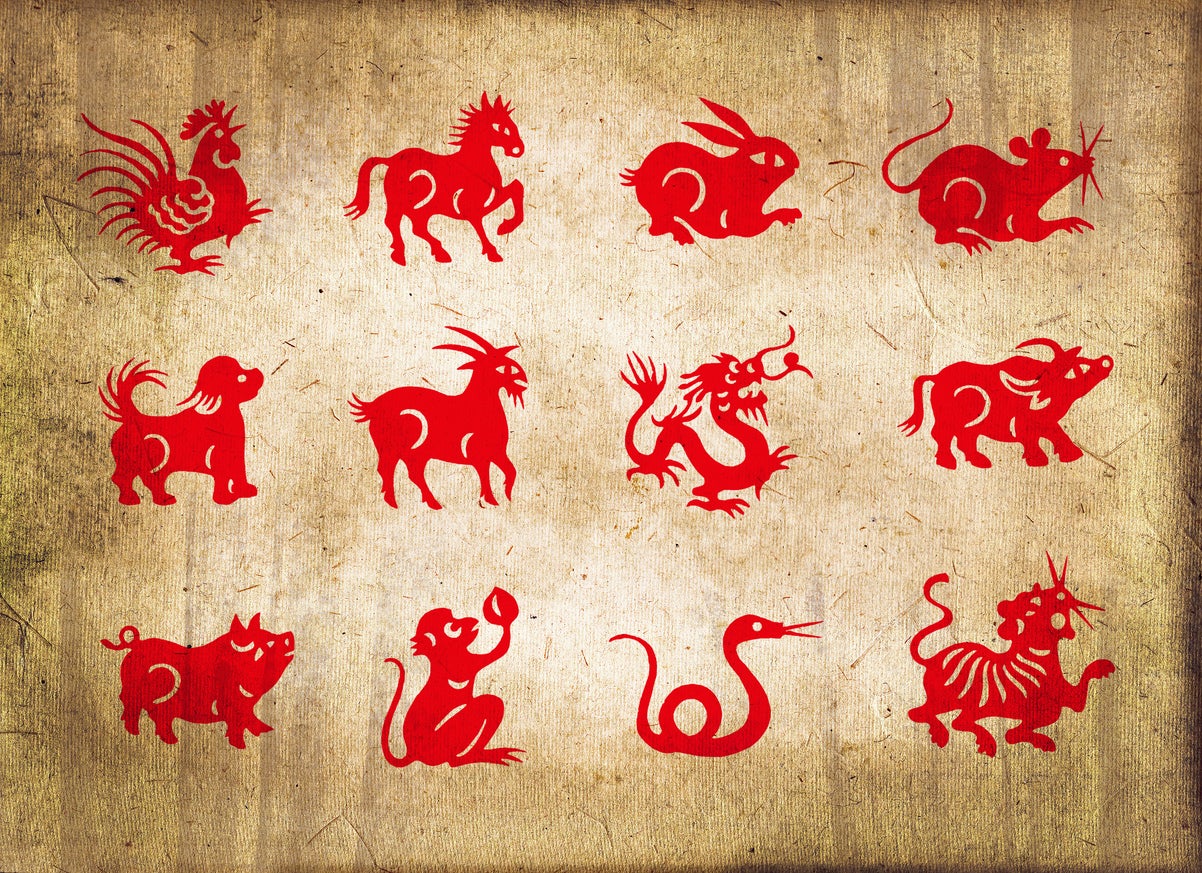
Cover: stylized red silhouettes of the twelve zodiac animals on a textured background. It illustrates the animal cycle; it does not label the five phases or prove personality traits.
The Chinese zodiac combines a twelve-animal cycle with a separate calendar system of ten Heavenly Stems. Those stems are associated with yin and yang and with wood, fire, earth, metal and water. Pairing stems with the twelve Earthly Branches produces a repeating sixty-year cycle, so an animal year returns every twelve years while the same animal-and-phase combination returns every sixty.
“Five elements” is the familiar English phrase, but wuxing is also translated as “five phases” or “five agents.” That wording helps: the system describes patterns of change and relationship, not five chemical substances. It is a traditional cultural and philosophical framework, not a scientific personality test, medical diagnosis or prediction of luck.
Quick guide
- The twelve animals and five phases are related calendar layers, not the same list.
- The phases are wood, fire, earth, metal and water.
- Generating and controlling cycles describe symbolic relationships among the phases.
- A birth-year shortcut needs a Lunar New Year check for January or February birthdays.
- Use phase descriptions as optional reflection, not fixed evidence about health, character or compatibility.
The twelve animals and five phases
The animals follow this order: Rat, Ox, Tiger, Rabbit, Dragon, Snake, Horse, Goat or Sheep, Monkey, Rooster, Dog and Pig. Each animal corresponds to an Earthly Branch. The phase and yin-or-yang quality come through the Heavenly Stem assigned to that year.
This means “Dragon” does not always mean wood, and “Rat” does not always mean water. A Wood Dragon year and a Fire Dragon year share the Dragon branch but have different stems. Popular charts sometimes give every animal a “fixed element”; that is a separate layer of correspondence and should not be confused with the element of a particular birth year.
What the five phases represent
Wood
Often associated with growth, spring, direction and development. As a prompt, ask what you are cultivating and what structure supports it.
Fire
Often associated with warmth, summer, visibility and transformation. As a prompt, ask where enthusiasm needs pacing or a clear purpose.
Earth
Often associated with grounding, transition, nourishment and stability. As a prompt, ask what is dependable and what needs maintenance.
Metal
Often associated with form, autumn, refinement and boundaries. As a prompt, ask what to preserve, edit or release.
Water
Often associated with winter, depth, adaptability and stored potential. As a prompt, ask what requires rest, observation or a different route.
These are broad symbolic associations, and sources and schools may frame them differently. They do not show that every person born in a Wood year is expansive or that every person born in a Metal year is rigid. Individual experience, family, culture, opportunity and choices cannot be reduced to one calendar label.
The generating and controlling cycles
Generating cycle
Wood feeds fire; fire leaves ash associated with earth; earth is associated with producing metal; metal is traditionally said to support or collect water; water nourishes wood. This sequence is a symbolic model of support and transformation.
Controlling cycle
Wood works through earth; earth contains or channels water; water controls fire; fire melts metal; metal cuts wood. This sequence models restraint and regulation, not destruction of a person or a guaranteed conflict.
The two cycles are not rankings. No phase is inherently stronger, luckier or morally better. The model is about relationships among processes, and traditional applications vary across philosophy, calendrical practice, feng shui, martial arts and Chinese medicine.
How birth-year phases are calculated
A common modern shortcut uses the final digit of a Gregorian year: 4 or 5 for wood, 6 or 7 for fire, 8 or 9 for earth, 0 or 1 for metal, and 2 or 3 for water. The paired digits reflect yin and yang versions of each phase.
The shortcut is not enough for everyone. The Chinese calendrical year does not begin on January 1, and Lunar New Year falls on a different date in January or February. If you were born near the start of the Gregorian year, use a reliable calendar for the exact birth date rather than assuming the Gregorian year’s animal and phase.
Calendar note: Different astrology systems may use Lunar New Year or the solar term lichun as a year boundary. State which convention a calculator uses. If two sources disagree for an early-year birthday, the difference may be the boundary rule rather than a calculation error.
A five-step way to read a year label
- Confirm the calendar boundary. Check the exact date for a January or February birth and note whether the source uses Lunar New Year or lichun.
- Identify the animal branch. Record the animal as a traditional year label, not a personality verdict.
- Identify the stem and phase. Note wood, fire, earth, metal or water, plus yin or yang when the source provides it.
- Separate tradition from inference. Mark which descriptions come from the system and which interpretations are your own.
- Compare with lived evidence. Keep a prompt only if it helps reflection; discard claims that stereotype, frighten or contradict observable facts.
Personality claims need limits
It can be enjoyable to compare a year label with personal experience, but a birth-year phase cannot establish intelligence, loyalty, mental health, career ability or relationship behavior. Lists of strengths and weaknesses are interpretations, not measured findings about everyone in a year.
Use first-person language such as “I connect Wood with steady growth” instead of “Wood people always lead.” If someone does not identify with the description, their account of themselves takes priority over the label.
Compatibility is not a verdict
Animal or phase pairings cannot prove that two people will be compatible, incompatible, faithful or unsafe. A relationship depends on mutual interest, consent, communication, commitments, circumstances and conduct. The Chinese zodiac labels and adult preferences guide shows how to keep symbolic language separate from individual desires and agreements.
Do not use a chart to pressure someone into intimacy, to excuse harmful conduct or to decide that a person is untrustworthy before learning what they actually do. Ask direct questions and accept the other person’s answer.
Health associations are traditional, not a diagnosis
Traditional Chinese systems connect phases with seasons, emotions, tastes and body organs. Those correspondences are part of a historical framework; a zodiac phase does not diagnose an organ problem, explain anxiety or prescribe food, herbs, exercise or treatment.
Do not delay medical care because a chart says an element is weak or excessive. For symptoms or treatment decisions, use an appropriately qualified health professional and share relevant medical information rather than a personality stereotype.
Use the phases in design and reflection
The five phases can be used as a creative vocabulary: growth, warmth, grounding, refinement and flow. You might choose one word as a journaling theme, compare how two phases describe a project stage or use traditional color associations as inspiration without treating them as compulsory lucky colors.
For a room or workspace, start with function, accessibility, comfort and budget. The zodiac-inspired interior design guide keeps symbolism optional while putting practical needs and personal taste first.
Key takeaways
- The Chinese zodiac’s animals, Heavenly Stems, yin and yang, and five phases combine in a sixty-year calendar cycle.
- Wuxing describes dynamic phases or agents as well as the familiar “elements” translation.
- Generating and controlling cycles are symbolic relationships, not rankings or predictions.
- Early-year birthdays require an exact calendar-boundary check.
- Birth-year labels do not diagnose health or determine personality, compatibility, luck or fate.
Frequently asked questions
Are Chinese zodiac animals the same as the five elements?
No. The twelve animals correspond to Earthly Branches, while the five phases are associated with the ten Heavenly Stems. The two cycles combine to label years within a repeating sixty-year system.
Can I find my Chinese zodiac element from my birth year’s last digit?
The last-digit shortcut often identifies the Gregorian year’s phase, but it can be wrong for a January or February birthday because the Chinese calendrical year does not begin on January 1. Check the exact date and the calculator’s boundary convention.
Does my element determine my personality or compatibility?
No. Phase descriptions are traditional symbolic interpretations, not verified measurements of personality or relationship outcomes. Use them as optional prompts and rely on observed conduct, communication and mutual choices.
Can an element imbalance diagnose a health problem?
No. Traditional correspondences are not a medical diagnosis and should not replace qualified care. Seek appropriate professional advice for symptoms, treatment, medication, diet or mental-health concerns.