

Updated
The astrology of nations, often called mundane astrology, applies astrological interpretation to public events and institutions. A national chart is constructed around a selected event. It is not an official measurement of a country’s personality, a diagnosis of its citizens or a proven forecast of political outcomes.
You can study the practice as a symbolic tradition while asking careful questions about its sources. The most useful starting point is the event and date behind the chart, followed by the choices used to construct it.
What mundane astrologers study
Deborah Houlding’s Skyscript glossary describes mundane astrology as a practice concerned with collective affairs. It lists techniques involving founding events, planetary cycles, eclipses and ingresses. This is a practitioner’s account of the tradition; it does not establish that the interpretations predict events accurately.
NASA distinguishes astrology from astronomy: astronomy uses scientific evidence and data, while astrology’s predictive and personality claims are not based on scientific evidence. Calculating where a planet appears is a different task from establishing what it means for a society.
Separate history, chart and interpretation
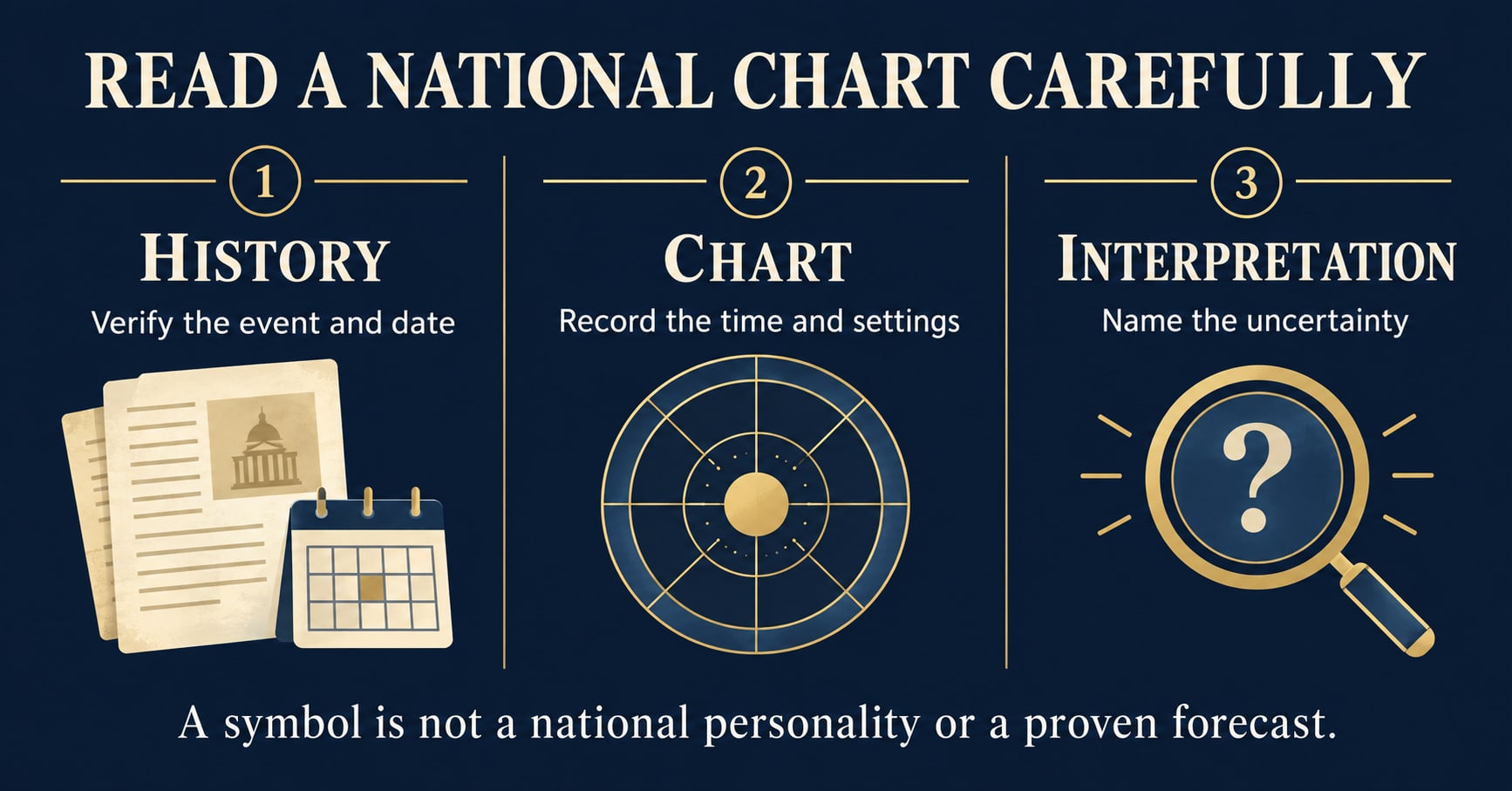
- History: What happened, and what does a reliable record say about its date and location?
- Chart: Which event, time, place and calculation settings did the astrologer choose?
- Interpretation: What meaning is being assigned, and how much uncertainty remains?
The featured infographic presents these three layers. Keeping them separate prevents a real historical date from being treated as proof of an astrological explanation.
A country can have several relevant dates
Independence, a constitution, a unification and a change of government are different events. Selecting one for a chart does not erase the others or establish a single moment when every community’s history began.
Ask the author to name the event precisely. “The country’s birthday” is not enough detail if the argument depends on a particular hour, city or legal milestone. A chart set to noon because the time is unknown should be labeled as an assumption.
Three historical examples to check
United States: adoption and signing are different
The U.S. National Archives records the Declaration of Independence’s adoption on 4 July 1776 and the start of signing the engrossed parchment on 2 August. Describing 4 July as the day all delegates signed confuses distinct events.
A chart associated with the adoption date still needs an explanation of its chosen time and place. The historical document does not validate an astrologer’s interpretation of that chart.
Germany: identify the reunification event
The German Federal Government’s reunification chronology identifies 3 October 1990 as the date of German reunification. A writer should describe that event accurately rather than using a vague label about Berlin.
The choice of a reunification chart also differs from choosing an earlier constitution or state formation. Explain the question the chart is intended to explore.
India: distinguish independence from the republic
India’s independence on 15 August 1947 and the republic beginning on 26 January 1950 are separate historical milestones, not interchangeable labels for one event. The President’s 2025 Independence Day address commemorates independence on 15 August seventy-eight years earlier. Article 394 of the Constitution identifies 26 January 1950 as its commencement date.
A reading based on one date should not silently borrow placements or interpretations from a chart based on the other.
What a transparent chart description includes
- The event’s name and a link to its historical source.
- The date, location and stated time, including whether the time is documented or assumed.
- The time convention or time-zone conversion used.
- The zodiac and house system selected.
- The source of the calculated positions. Our ephemeris reading guide explains the settings and notation to check.
- Any alternative event or time that would materially change the reading.
These details make the author’s method easier to inspect. They do not turn the interpretation into a demonstrated cause of elections, wars, economic changes or public emotion.
Do not assign one personality to millions of people
A phrase such as “a Capricorn nation” can hide several different ideas: a placement in one chosen chart, an association inherited from a tradition, or a modern writer’s metaphor. State which one you mean.
None of these is a sound basis for describing a nationality as secretive, obedient, emotional, spiritual or naturally aggressive. People within a country differ in language, beliefs, experience and political views. A government, a state and its population should not be treated as the same person.
Likewise, avoid explaining violence, colonization or hardship as a population’s karmic lesson. A symbolic narrative should not excuse responsibility or imply that people deserved harm.
Evaluate a prediction before fitting events to it
A broad statement such as “a period of transformation” can be matched to many developments afterward. To assess a predictive claim, preserve its original wording and publication date. Identify the place, time window and outcome it specified, and record misses and ambiguous results as well as apparent matches.
If the author changes the chart, expands the date range or replaces the predicted event after seeing what happened, record that change. A revised interpretation should not be counted as an unchanged successful forecast.
Our guide to intuition practices with reality checks offers related ways to keep observations separate from later interpretations.
Keep consequential decisions with suitable evidence
Use actual election information, reliable reporting, economic data and official safety guidance for decisions about public events. An astrological reading should not be your basis for moving money, ignoring an evacuation instruction or deciding a destination is safe.
A national transit also cannot explain or diagnose chest discomfort, fatigue or other symptoms. Seek appropriate healthcare advice instead of treating a physical problem as a collective energy shift.
Use the symbolism as a prompt you can question
If a theme such as responsibility interests you, turn it into a concrete question: “Which public decision do I want to understand better, and where can I read the original document?” That invites learning without requiring a claim that a planet caused the event.
You can appreciate an interpretation’s imagery and still find its evidence insufficient. A useful discussion leaves room for disagreement, historical complexity and uncertainty.
Frequently asked questions
1. What is the astrology of nations?
It is an application of astrology to collective events and institutions, often called mundane astrology. It interprets selected charts symbolically rather than providing an official national personality assessment.
2. Does every country have one agreed astrological birth date?
No. An author may select independence, a constitution, unification or another event. The choice and its historical source should be explicit.
3. Was the U.S. Declaration of Independence signed by everyone on 4 July 1776?
No. The National Archives distinguishes adoption on 4 July from the start of signing the engrossed parchment on 2 August. Chart descriptions should not confuse those events.
4. Which event does 3 October 1990 mark for Germany?
It marks German reunification. A chart using that date should identify this event and explain its selected time and location.
5. Are India’s independence and republic dates interchangeable?
No. Independence on 15 August 1947 and the republic beginning on 26 January 1950 are separate milestones. A reading should state which event it uses.
6. What if the event’s exact time is unknown?
Label the uncertainty and any assumed time. Do not present a convenient time, such as noon, as a documented historical fact.
7. What settings should a chart author disclose?
The event, date, time, location, time convention, zodiac, house system and source of calculated positions should be clear enough for someone else to inspect.
8. Does a correctly calculated chart prove the interpretation?
No. Calculating positions and demonstrating a claim about society are different tasks. A precise diagram can still support an uncertain interpretation.
9. What does calling a country a particular zodiac sign mean?
It might refer to a chosen chart placement, a traditional association or a metaphor. The writer should explain which meaning is intended instead of treating it as a national fact.
10. Can national astrology describe every citizen’s personality?
No. A country contains people with varied experiences, cultures and beliefs. A chart should not be used to stereotype a nationality or equate citizens with a government.
11. Does a transit show that a population deserves hardship?
No. An astrological interpretation does not establish collective guilt or a karmic reason for harm. It should not excuse violence or remove responsibility from human decisions.
12. How can I review a claimed successful prediction?
Keep the original dated wording, define the stated outcome and time window, and include misses and ambiguous results. Record any later change to the chart or interpretation.
13. Can I use a national chart for investment or safety decisions?
Do not rely on it for those decisions. Use appropriate factual information, qualified advice where needed and official safety guidance.
14. Can a national transit diagnose how I feel physically?
No. Physical symptoms need appropriate healthcare assessment. A collective-energy interpretation is not a medical explanation.
15. How can I explore the topic responsibly?
Read it as a symbolic tradition, verify historical claims, disclose assumptions and question interpretations. Use the themes to guide learning rather than to claim certainty about events or people.