

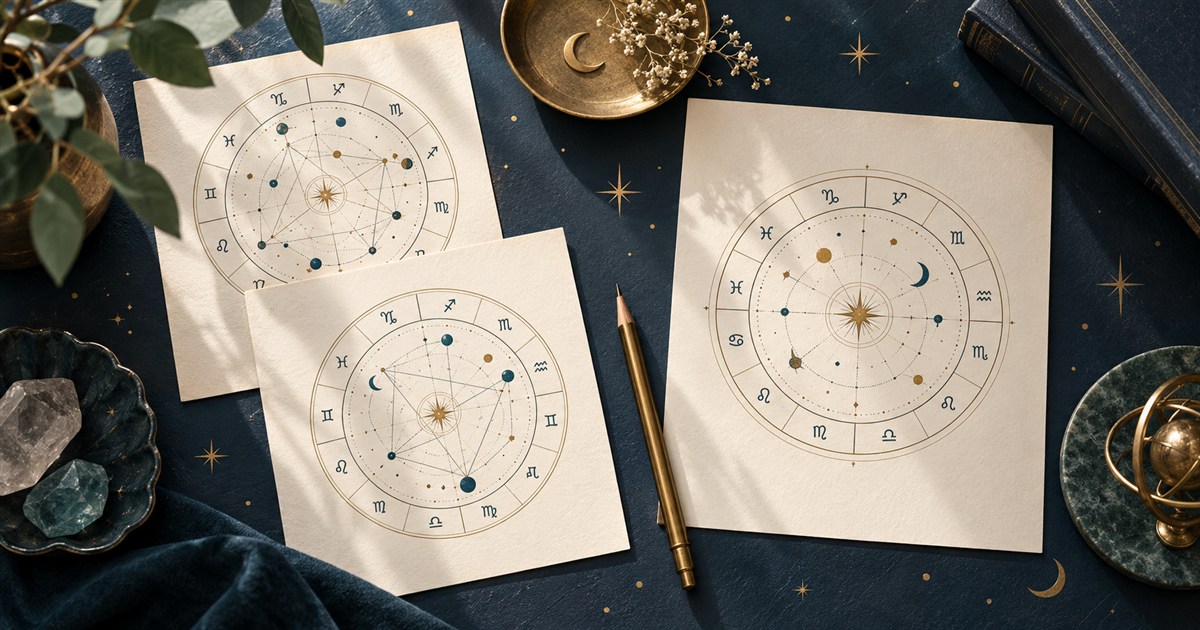
Synastry compares two birth charts; a composite chart combines corresponding positions into one symbolic chart of the relationship. Choose synastry when your question concerns differences between two people, and a composite when you want to explore a shared pattern.
Neither method can decide whether a relationship is healthy or predict its outcome. Start with a concrete question, reliable birth details and a willingness to check the interpretation against everyday behaviour.
Synastry and composite charts at a glance
| Question | Synastry | Midpoint composite |
|---|---|---|
| What is calculated? | Two natal charts compared | Midpoints between corresponding natal positions |
| What stays in view? | Each person's distinct placements | One combined relationship chart |
| Useful starting question | How do our approaches differ? | What pattern appears when we act together? |
| Does birth time matter? | Especially for houses, angles and Moon details | Time-sensitive natal information affects the combined chart |
| Can it decide compatibility? | No; observe behaviour and discuss needs | No; a symbolic pattern cannot make a relationship decision |
Scroll sideways to see the full table.
Understanding Synastry
When using synastry, the astrologer looks at the placements in one natal chart and compares them with placements in another. They might look at an angular relationship, called an aspect, between one person’s moon and the other person’s Mercury placement. They might also look at where one person’s planets fall in the other person’s houses when reliable birth times are available.
Astrodienst's guide to partner horoscopes describes synastry as one of several relationship-chart techniques. Its explanation is useful for understanding the method within astrology; it is not scientific evidence that the interpretation predicts relationship outcomes.
If you think about two transparent maps that are laid over each other, each person still has their own map. The comparison tells you to ask questions about their preferences, ways of expressing themselves, and habits. The image is just an analogy that helps explain why synastry keeps two distinct people.
A good reading might look at how each person views closeness, disagreements, or responsibilities. It can leave room for either person to say that the description does or doesn’t fit. A chart comparison isn’t useful when it turns someone into a fixed character that can’t grow or disagree with the story.
Understanding Composite Charts
A midpoint composite chart uses the midpoints between the corresponding natal positions. The composite Sun is calculated from two natal Suns, for example. The result looks like a birth chart, but it’s made in a way that makes it a relationship chart instead of a record of the person’s birth.
Astrodienst's composite-chart explanation also distinguishes calculation approaches, including differences in handling houses. This matters when two websites produce different-looking charts. Before interpreting that difference spiritually, check whether the tools used the same method and inputs.
Astrologers sometimes describe a composite as a way to look at the atmosphere and themes in a relationship. A good question might be to ask what patterns are created when you make decisions together. This question shows something shared instead of giving all the responsibility to just one partner.
Always pay attention to the language that suggests that the relationship is an independent being with authority over the participants. A shared pattern that’s symbolic can’t require anyone to be in a situation that hurts them. The people involved can change their agreements, get support, or leave, no matter what the composite chart suggests.
Synastry or Composite: visual guide
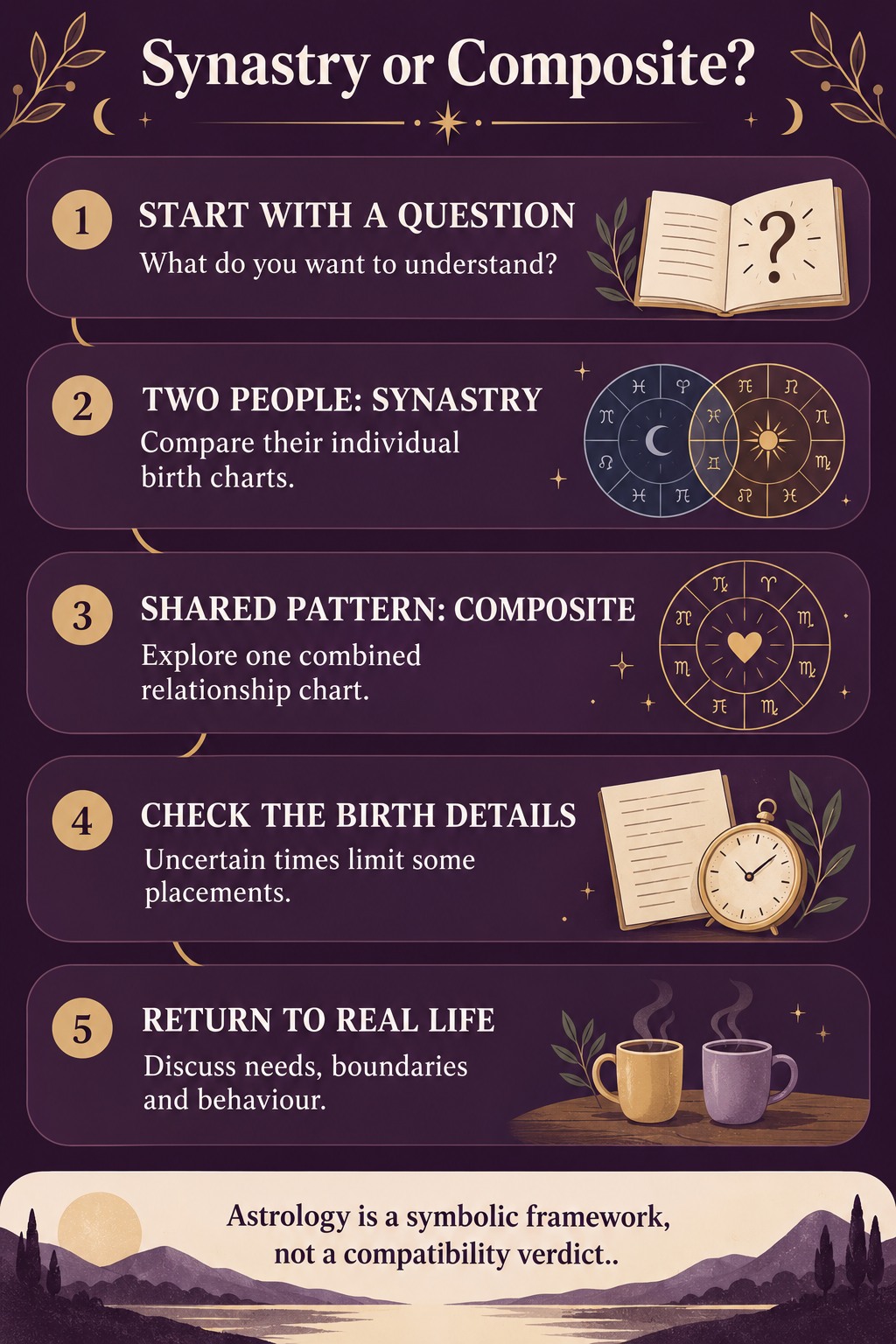
Read the infographic as text
- START WITH A QUESTION: What do you want to understand?
- TWO PEOPLE: SYNASTRY: Compare their individual birth charts.
- SHARED PATTERN: COMPOSITE: Explore one combined relationship chart.
- CHECK THE BIRTH DETAILS: Uncertain times limit some placements.
- RETURN TO REAL LIFE: Discuss needs, boundaries and behaviour.
Choose Your Question Before Choosing Your Chart
Synastry can be a good place to start when you want to understand how two people might approach the same situation differently. This might include things like how you communicate, how much personal space you each need, or how you prefer to show and receive affection. Since synastry compares two individual charts, it can help keep both people and their differences in view.
A composite chart might make more sense when you already understand each person separately and want to look at patterns that seem to come up within the relationship itself. For example, maybe both of you are normally organized on your own, but somehow making plans together always seems to get complicated. In that case, you are looking more at the relationship pattern than either person individually.
If this is a new connection, you might not know the person well enough yet to decide whether either interpretation really fits. Start with what you can actually see and experience. Pay attention to what the person says they want, how they respond to boundaries, and whether they follow through with plans. Even the most detailed astrology chart cannot replace actually getting to know someone.
You can also decide that neither chart is what you need. If you are wondering whether someone wants an exclusive relationship, for example, the best way to find out is to have that conversation with them. Astrology might help you sort through your own thoughts and feelings beforehand, but it cannot tell you what another person will say before they say it.
Compare the Methods Without Ranking Them
Synastry compares two individual birth charts, while a composite chart creates a new chart based on the two people together. Both usually use each person’s birth date and place, and having an accurate birth time becomes especially important when you are looking at things like houses and angles. A method does not automatically become more accurate just because the calculations behind it seem more complicated.
For beginners, synastry might feel a little easier to understand because you can usually connect different parts of the reading back to each person. A composite chart can sometimes feel more abstract because it focuses on the shared patterns within the relationship. That does not mean one method is better than the other. They simply look at the relationship from different perspectives.
Some astrologers use both methods. They might begin by looking at each person’s individual chart, move into synastry, and then look at the composite chart for another perspective on the relationship. Other astrologers prefer to focus on one method. If you are getting a relationship reading, ask the reader how they plan to keep each perspective clear. Paying for two different charts should give you two clearly explained ways of looking at the relationship, not twice as many scary statements about the same uncertainty.
The best fit is usually the method that you can understand, ask questions about, and connect with what you are actually experiencing in the relationship. If a reader cannot explain why a certain method makes sense for the question you are asking, adding more astrology terms probably will not make the reading more useful.
Missing Birth Times
If you’re not sure of your birth time exactly, it doesn’t mean that every planetary position is unknowable, but it does limit how precise the information is. The ascendant and houses depend strongly on the exact time. The Moon moves enough within a day that its degree, aspects, and sign might need to be treated as uncertain.
This uncertainty works into the relationship work. In synastry, the house overlays might be unreliable, but in a composite, time-sensitive natal information can affect the corresponding composite placements. A noon placeholder is a calculation convenience that doesn’t recover birth information.
Always tell the astrologer what you know, including what is approximate or missing. Ask which conclusions are usable across the possible time ranges, and which one should be left out. Don’t just convert “sometime before lunch” into an exact minute to try to force an answer.
It’s important not to search another person’s private records without their permission. If someone doesn’t want to share their birth details, you need to respect their choices. An interest in compatibility doesn’t mean they have a right to their personal information.
Separate Observations
Before you get a reading, write down a short description of an actual situation. You might say something like, “We both want to travel a lot, but the discussion stops when we get to a certain budget.” Tell what happened without guessing. This allows the interpretation to have something to look at.
Then separate the chart language from what you actually saw. A statement about contrasting approaches to security might become a question about spending preferences, but it doesn’t prove that one person is being selfish or the other is afraid to commit.
Try to record an interpretation, the observation that it’s related to, and the question that still remains open. This is a reflection exercise and doesn’t mean you’re compatible or not. The purpose is to stop a reading from becoming the only version of the relationship you consider to be real.
A Synastry Example About Communication
Imagine a fictional couple named Amira and Leo. When something difficult comes up, Amira likes to have some time to think before talking about it. Leo is the opposite and would rather talk about the problem right away. They decide to get a synastry reading to explore their different communication styles, while still understanding that astrology cannot tell them exactly what either person needs.
During the reading, the reader might point out a symbolic difference in how they process thoughts and emotions. Instead of treating that as a definite explanation for their communication problems, Amira and Leo can use it as a starting point for a conversation. Amira might explain that when she gets quiet, it does not mean she is ignoring Leo. She is usually trying to sort through her thoughts first. Leo might explain that when she walks away without saying when they will talk again, he is left wondering what is going on.
From there, they can come up with something that works for both of them. They might agree that it is okay to pause a difficult conversation as long as they decide when they will come back to it. That agreement can be helpful because they both agree to it and can see whether it actually works for them. They do not have to prove that something in their birth charts caused the communication difference in the first place.
If the interpretation does not sound like their relationship at all, they can leave it behind. A helpful reading can give a couple something new to think or talk about. It should not give them a script that they feel like they have to follow for the rest of their relationship.
A Composite Example About Shared Routines
Now imagine another fictional couple, Ellis and Rowan. They are both pretty good at handling their own work and responsibilities, but when it comes to things they share around the house, somehow things keep getting forgotten. They decide to look at a composite chart because they are interested in the patterns that seem to show up when responsibilities become shared.
The reading might bring up a symbolic theme involving unclear shared priorities. That could encourage Ellis and Rowan to take a closer look at what is actually happening at home. Once they talk about it, they realize that both of them have been assuming the other person will notice when something needs to be done. The chart might have helped start the conversation, but it is their own experiences and observations that show them where the problem really is.
They might decide to divide up certain responsibilities and have a quick check-in once a week. After a few weeks, they can see whether things are actually getting done and whether the arrangement feels fair to both of them. If it is not working, they can change it. They do not need another astrology reading to give them permission to try something different.
This is a good example of how a general spiritual interpretation might give someone an idea that they can try in everyday life. It does not mean that composite charts have been proven to identify household problems or make relationships better.
Conflicting Readings
A synastry reading might show a strong attraction, while a composite reading might show practical tension. These statements don’t automatically mean that you’re incompatible because attraction and difficulty can work together, but it doesn’t mean that every contradiction can be explained away indefinitely.
Look at what each claim says and what information supports it, and if it talks about something you’re able to recognize. Don’t accept an interpretation just because it can be fit into every possible outcome. If the reader uses the same placement to explain both staying together and separating, the claim gives you little usable guidance.
Remember that differences can come from house systems, birth data, aspect orbs, or the reader’s interpretive traditions. An orb is the permitted distance from an exact aspect. Different orb settings can change which connections appear in the chart.
You don’t have to make repeated purchases to make the reader agree with you. If an interpretation creates more confusion than guidance, go back to the actual question and the information that’s available without using astrology.
Compatibility and Behavior
A chart can’t tell if someone’s going to respect you, share responsibilities, or handle disappointments safely. These are things that become clear when you watch behavior over time. A promising interpretation doesn’t cancel a pattern that’s concerning, and a hard interpretation doesn’t get rid of respectful conduct.
The relationship spectrum from love is respect offers a behavior-based way to distinguish healthy, unhealthy, and abusive dynamics. Its guidance concerns relationships, not astrological compatibility, which is precisely why it can provide a useful independent reference.
If you feel pressured or scared, you don’t have to have another chart reading to justify getting the support you need. You also need to make sure you’re not using karmic lessons or soul contracts to tell your partner that they have to be mistreated. Spiritual language needs to make sure both people are free to make their own choices.
If you want to talk about everyday compatibility, talk about ordinary subjects directly with your partner, like how much time you want to spend together, what exclusivity means to you, and how money decisions should be made. These kinds of conversations are needed even when an astrological reading feels meaningful.
Beliefs and Relationships
One person might like astrology, and the other might see it as a way of storytelling. They can still talk about good questions without agreeing on what the chart says. Ask if both people are comfortable participating and what kind of language makes them feel respected.
Instead of saying that a placement proves that your partner avoids responsibility, for example, talk about the commitment that was missed and ask how to look at it differently. This kind of conversation is then accessible even if someone doesn’t have the same astrological beliefs.
If only one person wants to have a reading, keep the conclusion in the personal reflection. Don’t present the partner who’s not there with a diagnosis given by a reader they never agreed to talk to. A meaningful practice can work with another person’s freedom to look at the relationship differently.
Final Thoughts: Preparing for a Reading
To prepare for a reading, focus on one or two questions, identify uncertain birth details, and then figure out how much you want to spend on the reading. Ask if the reader will use synastry, a composite, or both, and how they handle claims about someone who’s not there.
If both partners attend the reading, agree that both people can disagree with an interpretation if they need to. Don’t turn the reading into a contest over whose chart talks about every problem. The reader’s role should never replace mutual listening.
Pick one takeaway after the reading period. You might ask better questions, pay attention to recurring interactions, or talk about an agreement that needs updating. Leave the rest as possibilities instead of creating a long list of predictions that you have to monitor.
Synastry and composite charts give different symbolic perspectives. Pick synastry to look at interactions between people, and composite to reflect on shared patterns, but keep the experience real. Always remember that consent and personal judgment are at the center of every relationship.
For another perspective on using a relationship chart, read our guide to couple astrology.
For the next step, explore how to read an astrology ephemeris.
Frequently asked questions
1. What is the main difference between synastry and a composite chart?
Synastry compares two separate natal charts. A midpoint composite calculates a new chart from corresponding natal positions, which astrologers interpret as a symbolic picture of the relationship.
2. Which chart should a beginner use first?
Synastry is often easier to follow because you can connect placements to each person. Start with the question you want to explore rather than treating one technique as universally better.
3. Can I use both methods?
Yes. Keep the perspectives separate: individual charts first, interactions in synastry next, then shared patterns in the composite. More charts are useful only if they clarify the question.
4. Do both people need an exact birth time?
Reliable birth times are important for houses and angles. Without them, some comparisons remain possible, but time-sensitive placements should be marked uncertain rather than presented as precise.
5. Is a noon birth time an acceptable substitute?
A noon placeholder helps a program calculate a chart, but it does not recover the missing birth time. Tell the reader that it is a placeholder and ask which conclusions depend on it.
6. Can a composite chart replace a natal chart?
No. It is derived from two natal charts and represents a different interpretive perspective. It is not a record of a person's birth and should not be used to diagnose either partner.
7. Is a Davison chart the same as a composite?
No. A midpoint composite combines corresponding chart positions. A Davison relationship chart uses a midpoint in birth time and location. Ask which method your reader or software is using.
8. Why do two websites produce different charts?
Check birth details, time zones, daylight-saving settings, house systems and calculation methods. Differences in inputs or settings can change a chart before interpretation begins.
9. What is an aspect orb?
An orb is the allowance around an exact angular relationship. Different orb settings can change which aspects are displayed, so comparisons should use consistent settings.
10. What if synastry and the composite seem to disagree?
They describe different perspectives within astrology. Identify the specific interpretation and compare it with the situation; do not invent an explanation that makes every possible outcome fit.
11. Can a chart prove someone is my soulmate?
No. A meaningful symbolic interpretation does not establish a unique destined partner, mutual consent or a healthy relationship. Those require real information and communication.
12. Do difficult aspects mean we should separate?
No aspect can make that decision. Consider behaviour, needs, safety and agreements. If a relationship is harmful, you do not need astrological permission to seek support or leave.
13. Can these charts be used for friendships or work partnerships?
Astrologers also compare non-romantic relationships. Frame the question around the actual relationship, such as collaboration or communication, rather than importing romantic assumptions.
14. Do I need my partner's permission to use their details?
Respect their privacy and ask before obtaining or sharing personal birth information. An interest in compatibility does not justify searching private records without consent.
15. How should I prepare for a relationship reading?
Choose one or two questions, note uncertain birth details and set a budget. Ask which methods the reader uses and how they handle uncertainty, privacy and interpretations about an absent person.