

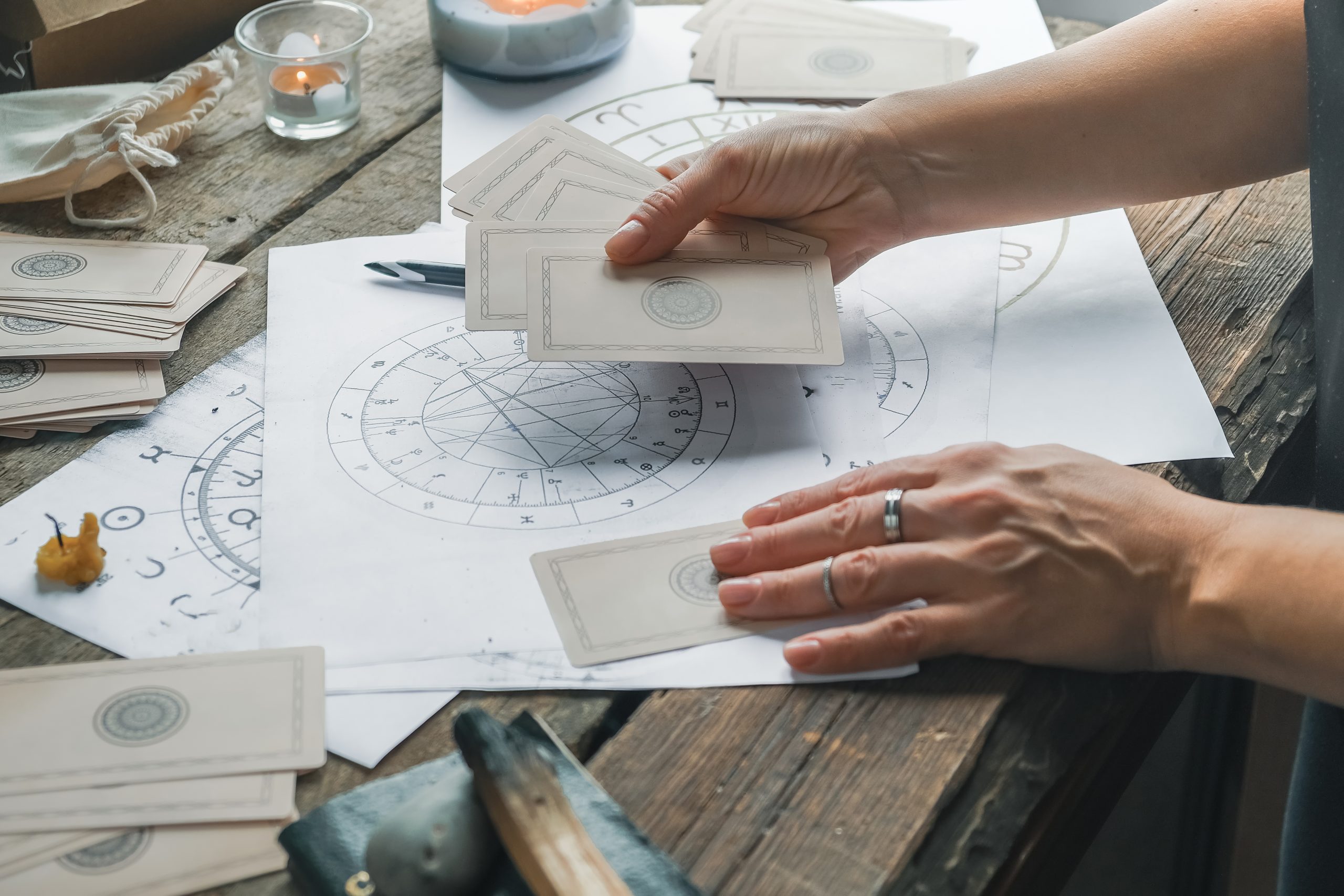
Cover: illustrative cards-and-chart tabletop study, not a verified client reading or proof of a chart’s accuracy.
Some readers connect zodiac signs with tarot cards as a symbolic study framework. A pairing can suggest a question, but it does not identify your character, reveal another person’s private feelings or establish your purpose. You do not have to use a sun-sign card, accept a reading or act on its interpretation.
Quick Guide
- Identify the correspondence system you are using.
- Read the card as a prompt, not a personality verdict.
- Keep observation separate from interpretation.
- Check real information before consequential decisions.
A correspondence system, not a universal rule
Labyrinthos practitioner Tina Gong’s correspondence guide lists the twelve sign–card pairings below. We use that guide only to identify its pairings, not to endorse its personality descriptions or spiritual claims. A practitioner’s framework is not evidence that the stars determine what a card means for you.
Ask which guide or deck a reader follows. A different interpretation does not make you deficient, and a dramatic card is not automatically more insightful. You can learn the system while declining claims that it measures your abilities or predicts an outcome.
Twelve pairings with optional notebook questions
The sign–card labels follow the cited guide. The questions are independently invented for this article; they are not statements about people born under a sign. Anyone can try any question, change it or leave it unanswered.
- Aries — The Emperor: What limit would make this task manageable?
- Taurus — The Hierophant: Which inherited rule do I want to examine rather than obey automatically?
- Gemini — The Lovers: What information do I need before choosing?
- Cancer — The Chariot: Which next step is within my control?
- Leo — Strength: How could I respond without pressure or force?
- Virgo — The Hermit: Would a short pause help me formulate a clearer question?
- Libra — Justice: What would fair treatment look like in this situation?
- Scorpio — Death: What ordinary ending or change am I considering?
- Sagittarius — Temperance: Which competing priorities need a workable balance?
- Capricorn — The Devil: Which habit or commitment do I want to reconsider voluntarily?
- Aquarius — The Star: What hopeful idea could I examine without assuming a promised result?
- Pisces — The Moon: What is uncertain, and what could I check directly?
Three checks for a grounded reading
Observation
Describe the actual image or card you selected without adding a prediction.
Interpretation
Write the optional idea it brings to mind and label it as your interpretation.
Reality check
Ask what direct information supports or contradicts the idea before acting.
A three-card spread is not automatically the “big three”
The earlier article blurred a three-card draw with Sun, Moon and rising-sign symbolism. Drawing three cards does not calculate those chart placements. If you choose to assign those labels to a spread, state that it is your exercise rather than a measurement of identity, emotion or energy.
You could instead name three positions “question,” “possibility” and “information to check.” The labels organize a notebook session; they do not reveal what is happening inside another person. The Moon-sign inputs guide explains why chart data and settings are separate from emotional or character claims.
Do not let card names become alarming labels
Death is not proof that someone will die. The Devil does not establish that a Capricorn person is harmful, trapped or morally bad. Justice does not promise that karma will punish someone, and the Emperor does not authorize force or control.
Look at actual behaviour and circumstances rather than declaring a relationship safe, toxic or destined from a card. No interpretation creates consent, obligates forgiveness or requires you to stay. If a reading pressures you to pay more to remove a curse or prevent a predicted disaster, do not treat the claim as evidence that further spending is necessary.
Use a card without making it a verdict
At a modest home desk, choose one card or one question. Write a plain description, the idea you associate with it, one real example and one contradiction or uncertainty. You do not need an elaborate room, a ritual purchase or repeated draws until you get a reassuring answer.
An invented example: after selecting a card, a person writes, “I want clearer limits on my workload.” The next step might be checking existing commitments, not announcing that the card has revealed their destiny. If the idea does not fit, leave it behind.
The intuition reflection guide keeps impressions distinct from evidence. Apply that distinction here: an image may stimulate a useful question without establishing an unseen truth.
Keep consequential decisions outside the reading
A card cannot diagnose illness, identify an investment, establish guilt, confirm fidelity or supply someone else’s permission. Use qualified advice, current information and direct communication where those matters are involved. Do not change treatment, borrow money or accuse someone because a reader presents a symbol as certainty.
You can enjoy a symbolic exercise without making those claims. Stopping, asking for a less alarming interpretation or declining the session are legitimate choices.
Key Takeaways
- Pairings belong to an identified interpretive framework.
- Optional questions are not sign-based personality facts.
- Card names do not forecast harm or authorize pressure.
- Observation, interpretation and real evidence should remain distinct.
Frequently asked questions
Does every tarot deck use the same zodiac correspondences?
No. This guide presents the twelve pairings listed by the cited Labyrinthos practitioner. Treat them as an interpretive framework rather than a rule binding every deck or reader.
Can a card reveal someone else’s hidden feelings?
No. A drawn card does not establish another person’s thoughts, intentions or consent. Ask directly when appropriate and respect their choice not to share.
Do Death and the Devil predict harm or label a person?
No. Do not treat these card names as a death forecast, a diagnosis, a moral judgment or proof of a toxic relationship. Examine actual circumstances and behaviour instead.
How can I use a sun-sign card responsibly?
Use it as an optional notebook prompt, distinguish what you see from what you interpret, and check any consequential idea against real information. You may skip the exercise or choose another card.